Ongoing, done-for-you care that keeps your WordPress website secure, updated, backed up and fast, looked after by real WordPress developers, not a dashboard. Compare what each plan includes, see how we care for your site each month, and pick the fit that matches what your website is worth. No contracts, cancel anytime.
A WordPress care plan is a monthly service that looks after your site for you: updates, security, daily backups, speed and a developer on call, all for a flat fee. Ours run from $59/mo for small sites to $249/mo for stores and agencies, with no contracts. This page explains what a care plan really is, how it differs from what your host does, what each plan covers, and how to choose. For general market pricing across all providers, see our website maintenance cost guide, and for the plans framed around "maintenance," our website maintenance plans page.
A WordPress care plan is an ongoing service that looks after your website after it launches, so it stays secure, current and fast without you having to manage the technical side. For a fixed monthly fee, a team handles the recurring work every live WordPress site needs, and steps in when something goes wrong. Think of it the way you would a service plan for a car: the vehicle runs fine today, but it needs regular attention to keep running, and skipping that attention is how small issues become expensive breakdowns.
The term "care plan" comes from the WordPress community itself. As WordPress grew into the platform behind a huge share of the web, agencies and freelancers began offering monthly retainers to keep client sites healthy, and "care plan" became the friendly name for it, emphasising that a real person cares for your site rather than leaving it to chance. You will see the same service sold as website maintenance plans, WordPress support plans, or managed WordPress care. Underneath the branding, they describe the same commitment: someone reliable keeps your website in good shape, every week, so you do not have to.
A real care plan is built around six areas of work: keeping WordPress and its plugins updated, defending the site against attacks, backing everything up daily, keeping pages fast, monitoring for downtime, and fixing problems when they appear. The trap to avoid is the cheap "care plan" that only automates updates and calls it done. Automating an update is not the same as caring for a site, because the moment an update conflicts with your theme or a plugin, an automated system just moves on while your site sits broken. Care means a human notices and fixes it.
Honestly, very little. "Maintenance plan" and "care plan" are two names for the same service, and providers use them almost interchangeably. If there is a shade of difference, it is one of emphasis. "Maintenance" leans on the technical upkeep, the updates, patches and backups. "Care" leans on the relationship, the sense that a real person is looking after your site and is there when you need help. Some agencies deliberately choose "care plan" to signal that you are buying attention from humans, not just access to automated tooling.
What actually matters is not the word on the pricing page but the scope of work behind it. A cheap plan called a "care plan" that only runs automatic updates is worse than a well-built plan called a "maintenance plan" that covers all six core jobs. When you compare providers, ignore the label and read the inclusions. Ask what happens when an update breaks something, whether backups are stored off-site, and who actually responds when you have a problem. Those answers tell you far more than whether they picked "care" or "maintenance" for the headline.
Do not overthink the name. Compare what is included, how fast they respond, and whether a real developer stands behind it. That is what separates a plan that protects your site from one that just looks like it does.
WordPress is powerful precisely because it is extensible, but that same flexibility is what makes ongoing care essential. Every plugin and theme you add is third-party code that needs to stay current, and the numbers from 2025 and 2026 show why leaving it alone is a gamble.
The reassuring news is that WordPress core is very secure; only a handful of core vulnerabilities surfaced in all of 2025. The risk lives in the plugins and themes that make your site yours, where researchers catalogued more than eleven thousand vulnerabilities in a single year. Because WordPress runs such a large slice of the web, automated bots scan for these flaws constantly, and the median gap between a vulnerability being disclosed and the first exploit attempt is around five hours. That is the window a care plan closes. Most sites that get hacked were simply running something out of date, the exact thing regular care prevents.
Security is only half of it. Websites also decay in quality over time: databases bloat, images pile up unoptimized, and each new plugin adds weight, so a site that launched fast gradually slows down. Since Google treats speed as a ranking factor and only about a third of mobile WordPress sites currently pass Core Web Vitals, a neglected site quietly loses both rankings and conversions. Ongoing care keeps the site fast as well as safe, which is why a care plan is best understood not as a cost but as protection for an asset that is actively earning for your business.
This is the most common reason people skip a care plan, and it comes from a reasonable misunderstanding of what hosting actually does. Managed WordPress hosts like Kinsta, WP Engine and Cloudways are excellent, and they will keep the server running, often run automatic core updates, and take basic backups. But hosting looks after the server your site sits on, not the site itself. Those are two different layers, and the gap between them is where most problems live.
Here is what even good hosting typically does not do. It does not test updates against your specific combination of theme and plugins, so an automatic update can still break your layout or your checkout. It does not clean malware out of your site if you get infected, that is your problem to solve. It does not optimize your speed beyond server-level caching, so a bloated database or heavy plugins still slow you down. It does not fix your contact form when it stops sending, rebuild a page, or answer at 2am when your site goes white. And host backups are often on the same infrastructure and limited in retention, which is not the off-site safety net you want when something serious happens.
| Job | Your host | A care plan |
|---|---|---|
| Keep the server running | Yes | Not needed |
| Test updates against your plugins | No | Yes |
| Clean malware from your site | No | Yes |
| Optimize site speed & Core Web Vitals | Server-level only | Yes |
| Off-site backups you control | Sometimes, limited | Yes, daily |
| Fix things & answer questions | No | Yes |
Good hosting and a care plan are partners, not substitutes. The host protects the foundation; the care plan protects the house you built on it. You want both, and a care plan is the layer most site owners are missing.
Every plan is built on the same six foundations. Here is what each involves in practice, so you know exactly what your monthly fee buys.
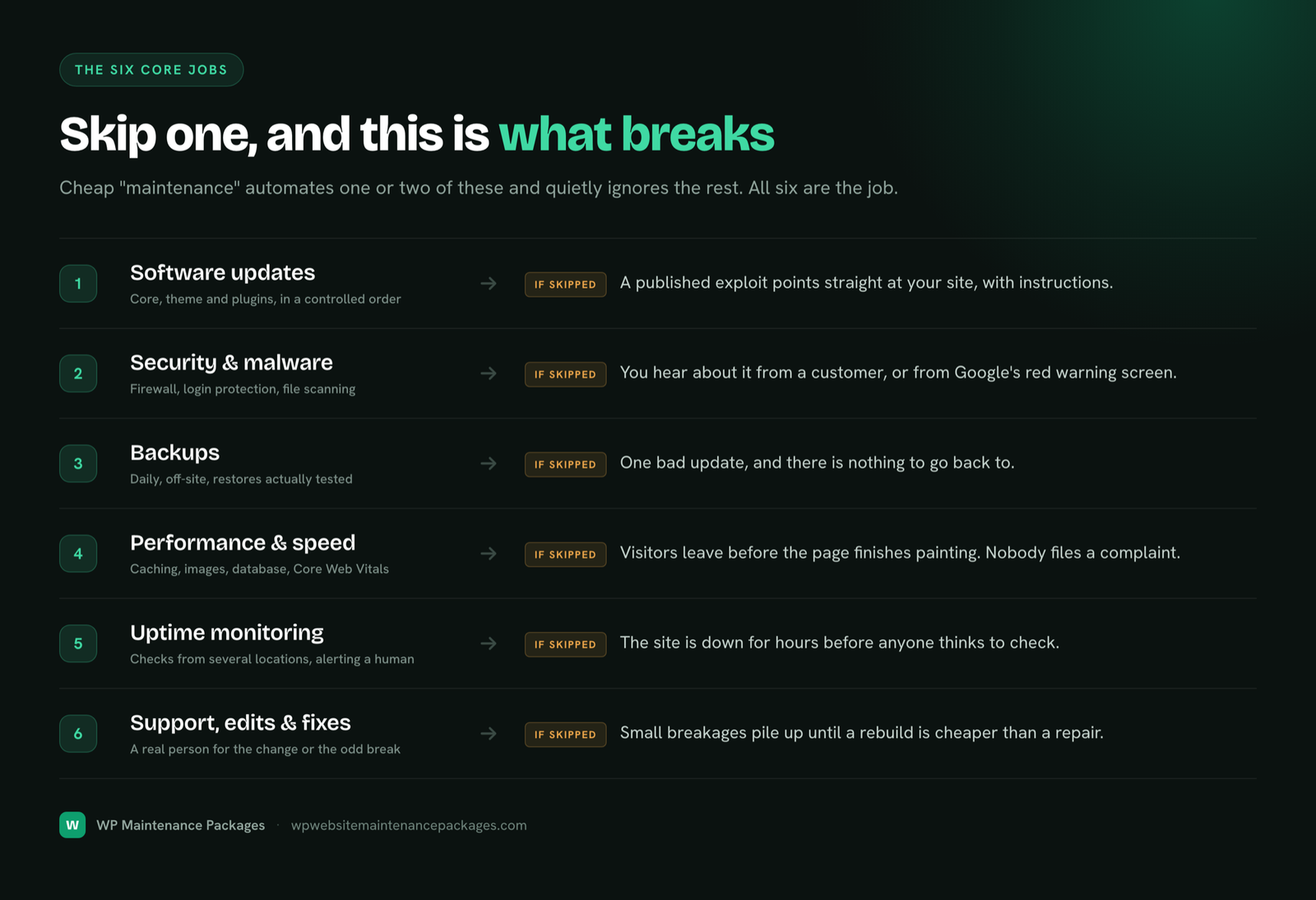
WordPress core, themes and plugins updated weekly, backed up first and tested after, with major updates staged before they touch your live site. Updates that fix problems, not cause them.
Firewall, login protection, file-change monitoring and regular scans, plus cleanup and hardening if anything ever gets through. We follow WordPress and OWASP security best practices.
Automatic daily backups stored off-site, so a server failure can never take your backup with it, and any change is reversible in one click.
Caching, image optimization and database cleanup to keep pages fast and Core Web Vitals healthy, which protects both experience and rankings.
Round-the-clock uptime monitoring that alerts us the moment your site goes down, plus a plain-English monthly report so you can see the care happening.
Small fixes, edits and the occasional emergency handled by a human who knows your site, from a broken form to the dreaded white screen, not a ticket queue.
Three plans, no hidden fees, no lock-in. Each puts a real WordPress developer on your side for less than the cost of a single emergency call-out.
The safety net for small sites that need to stay secure and online.
Full care plus speed work and real developer time every month.
Hands-on care for stores, high-traffic sites and agencies.
Prefer to see these framed as maintenance, or need the full service breakdown? Visit our maintenance plans and WordPress maintenance services pages.
The exact differences between the plans, so you can see what you get at each tier at a glance.
| Feature | Essential $59 | Growth $129 | Pro $249 |
|---|---|---|---|
| Weekly updates (core, theme, plugins) | ✓ | ✓ | ✓ |
| Daily off-site backups | ✓ | ✓ | ✓ |
| 24/7 uptime monitoring | ✓ | ✓ | ✓ |
| Security hardening & malware scans | ✓ | ✓ | ✓ |
| Monthly health report | ✓ | ✓ | ✓ |
| Speed & Core Web Vitals tuning | — | ✓ | ✓ |
| Same-day malware cleanup | — | ✓ | ✓ |
| Priority support (under 4 hrs) | — | ✓ | ✓ |
| Staging-tested updates | — | ✓ | ✓ |
| Developer / edit time | — | 2 hrs/mo | Unlimited small |
| WooCommerce / store support | — | — | ✓ |
| Dedicated account manager | — | — | ✓ |
| White-label reports (agencies) | — | — | ✓ |
| SEO blog posts / month | 1 | 2 | 3 |
| Contract | None | None | None |
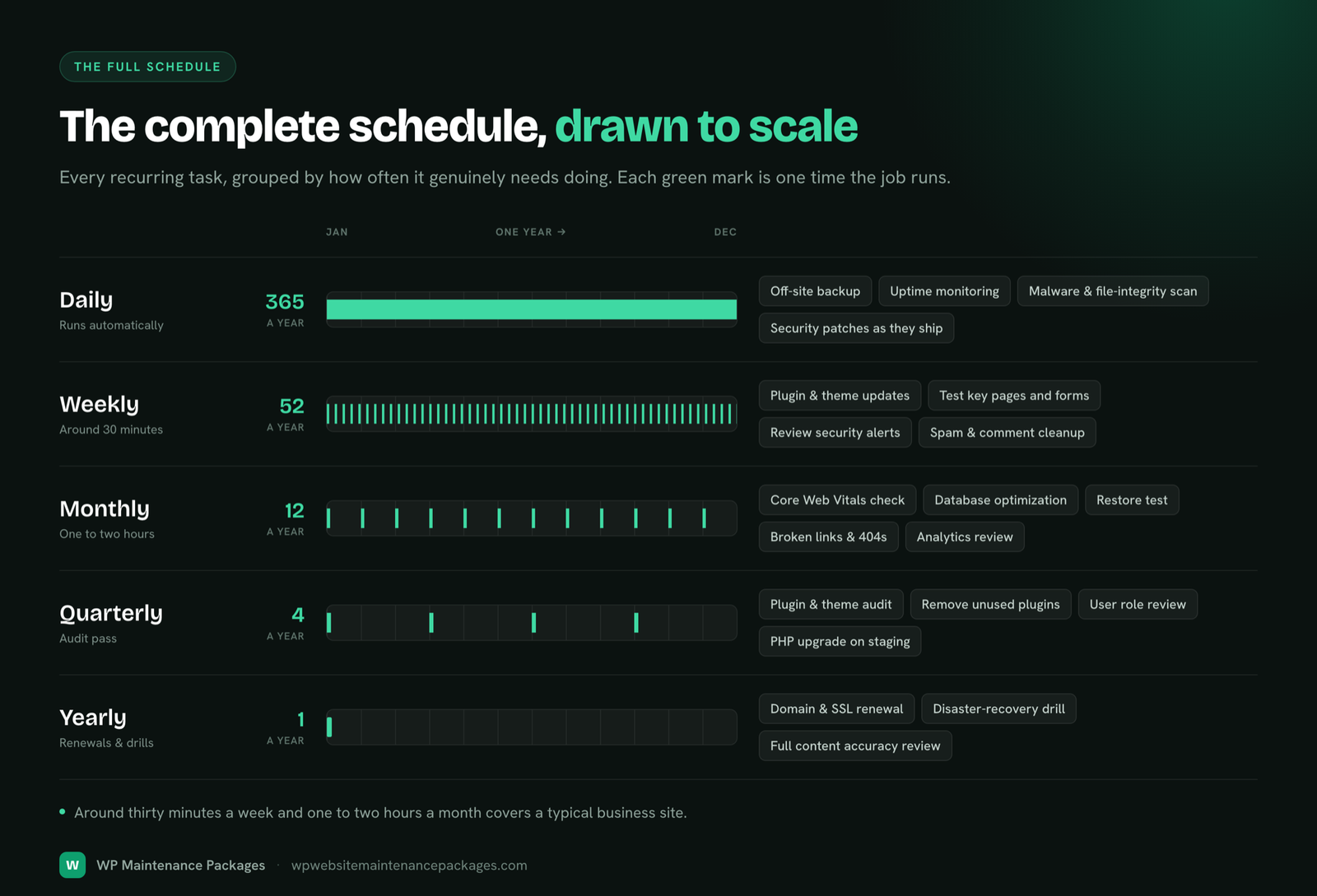
Care only works if it happens on a schedule, not when someone remembers. Here is the rhythm we run for every site on a plan.
We audit your site, take a full backup, harden security and bring everything current before day-to-day care begins.
Weekly tested updates, continuous monitoring and security scanning keep the site safe and current every week.
Monthly speed passes, database cleanup and health checks keep the site fast and Core Web Vitals healthy.
A plain-English monthly report shows what we did, what we blocked, and where your site can improve next.
This is the cadence behind the care, the same routine a good in-house team would run, handled for you.
The right plan matches what your site is worth and how much it does. Overpaying for coverage you will not use is as much a mistake as leaving a valuable site underprotected. Here is a simple guide.
| Your site | Best plan | Why |
|---|---|---|
| Personal / brochure site | Essential | Needs protection and uptime, not ongoing dev time |
| Small business (leads & forms) | Essential → Growth | Growth adds speed work and monthly edits |
| Blog / content site | Growth | Speed and regular edits protect SEO traffic |
| WooCommerce / store | Pro | Store support and fast response protect sales |
| High-traffic / SaaS | Pro or custom | Complexity and uptime stakes justify hands-on care |
| Agency (many client sites) | Pro / Agency | White-label reports and volume-friendly care |
Still unsure? Send your URL for a free audit and we will recommend the honest fit, even if that is the cheapest plan. To sanity-check the price against the wider market first, our cost guide lays out 2026 pricing by site type.
You can care for a WordPress site yourself, and for a low-stakes personal project that is a fine choice. The question for a business site is whether DIY is actually cheaper once you count your time and the risk. Proper care runs around five hours a month: reviewing and testing updates, checking backups, running scans, cleaning the database and handling small fixes. Valued at even a modest rate for your own time, that is $250 or more a month, and it assumes nothing goes wrong. One untested update on a live site, or one missed patch during that five-hour exploit window, can turn a quiet afternoon into a paid emergency.
| What you get | Professional care plan | DIY |
|---|---|---|
| Weekly tested updates | Included | Your time, ~5 hrs/mo |
| Daily off-site backups | Included | Plugin + setup + checks |
| 24/7 monitoring | Included | Rarely set up properly |
| Same-day fix when it breaks | Included | Panic + paid emergency |
| Real cost | From $59/mo | $250–$500/mo of your time + risk |
For a site that earns money, a care plan almost always costs less than your own hours and removes the downside entirely. That is why most owners who start out doing it themselves eventually hand it over.
A big part of care is catching problems before they become emergencies, and that only works if someone is actually watching the right signals. Automated monitoring runs continuously in the background, and anything that looks wrong triggers an alert to a real person, not just a log entry nobody reads. Here is what we keep an eye on.
Monitoring is the difference between a care plan that reacts and one that prevents. Most of the problems we handle are resolved before the site owner is even aware anything happened, which is exactly how good care should feel: quiet.
Care you cannot see is easy to doubt, so every month you get a plain-English report, no jargon, that shows exactly what happened and where your site stands. It is a one-page answer to "what am I actually paying for?" and it typically covers:
The report does two jobs. It proves the work is happening, and it keeps a running record of your site's health over time, which is invaluable if you ever sell the site, switch providers, or just want to understand how it is trending.
The value of a care plan is easy to miss month to month, because when it is working, nothing dramatic happens. That is the point. Zoom out to a year, though, and the compounding effect is real. A cared-for site stays continuously patched, so it never joins the majority of hacked sites that were simply running something out of date. It stays fast, so it holds or improves its search rankings instead of slowly sliding as competitors speed up. It accumulates a year of clean, tested backups, so any mistake is a one-click fix rather than a crisis. And it avoids the expensive catch-up work, the several thousand dollars it typically takes to safely revive a site neglected for six months or more.
Put simply, a year of care costs a predictable, modest amount and quietly prevents the handful of expensive, stressful events that hit neglected sites. It is the cheapest insurance a business website buys, and unlike insurance, it also actively improves the asset it protects. For most owners, the honest math is not "can I afford a care plan?" but "can I afford the emergency that a care plan would have prevented?"
If your website does a job for your business, it needs care, and the more directly it touches revenue, the more that care matters. Local service businesses (HVAC, plumbing, dental, legal) depend on their site to capture leads, so uptime and working forms are critical. WooCommerce stores have the most at stake, since every minute of downtime is lost sales and checkout has many moving parts. Content and blog sites rely on speed and consistency to protect hard-won SEO traffic. Membership, LMS and booking sites have complex integrations that break quietly without upkeep. And agencies need reliable white-label care so they can look after client sites without doing every update themselves.
The honest exception: a low-stakes personal site that earns nothing and rarely changes may not need a paid plan at all. Do not buy care out of guilt, buy it when the site is worth protecting. For everyone whose website is part of how they make money, a care plan is one of the highest-return, lowest-drama expenses in the business.
We work on WordPress and WooCommerce only, so we catch what generalists miss.
Month to month, cancel anytime. We earn your business every month.
Priority and same-day support on higher plans, with monitoring that catches issues first.
A human who knows your site handles fixes, not a ticket queue or a bot.
Every update is backed up and tested. If anything ever goes wrong on our watch, we roll it back and make it right at no cost, every plan, every time.
Good care is not just doing the tasks; it is doing them the right way, so the work never becomes the thing that breaks your site. A few principles guide everything we do, and they are worth asking any provider about before you hand over your website.
These are not glamorous, but they are exactly what separates care that protects a site from care that occasionally breaks one. The discipline is the product.
Onboarding is simple and takes about a day, with no long forms and no pressure.
Send your URL. We run a full health, security and speed check and tell you honestly what shape your site is in.
Choose the tier that fits, or take our recommendation. Month to month, no contracts.
Give us secure access. Within 24 hours we audit, back up, harden and bring everything current.
We care for the site on autopilot, and you get your time back plus a clear report each month.
Only need one thing fixed? We also handle one-time WordPress fixes from $99, no plan required.
A WordPress care plan is an ongoing monthly service that looks after your WordPress website after it launches, keeping the software updated, the site secure, backups running, pages fast, and a real developer on hand to fix things. "Care plan" is simply the WordPress community\u2019s name for a maintenance retainer. The label matters less than what is inside: a genuine care plan covers security, updates, backups, speed, monitoring and support, not just automatic updates.
In practice, nothing, they are two names for the same thing. "Maintenance plan" emphasises the technical upkeep; "care plan" emphasises the ongoing relationship and support. Some providers use "care plan" to signal that a real person looks after your site rather than just automated tooling. What actually matters is the scope of work included, not which of the two names a provider chooses.
A proper care plan covers six things: weekly core, theme and plugin updates; active security with malware scanning and cleanup; daily off-site backups; speed and Core Web Vitals optimization; 24/7 uptime monitoring; and fixes from a real developer. Higher tiers add staging, priority support, monthly developer hours and WooCommerce support. Anything that only automates updates is not a real care plan.
Most WordPress care plans run $20 to $500 per month in 2026, with stores and high-traffic sites higher. Ours are $59/mo for essential care, $129/mo for full care with speed work and developer time, and $249/mo for stores and agencies. For how that compares across the whole market, see our website maintenance cost guide.
Usually yes. Managed hosting looks after the server, and often runs automatic core updates and basic backups, but it does not test updates against your specific plugins, clean malware from your site, optimize your speed, or fix things when they break. Hosting protects the server; a care plan protects your website. They cover different layers, and the gap between them is exactly where most problems live.
Match the plan to what your site is worth. Brochure and small business sites fit Essential or Growth; content sites that publish regularly fit Growth for its speed work and edits; stores, high-traffic sites and agencies fit Pro for store support and fast response. If you are unsure, send your URL for a free audit and we will recommend the honest fit, even if it is the cheapest one.
No lock-in contracts. Every care plan is month to month, and you can upgrade, downgrade or cancel any time, with changes taking effect at your next billing cycle. Annual billing is available at a discount if you want it, but it is never required.
Founder, ThinkFlow Media & Linkflow.agency · 8+ years in WordPress & SEO
Bhupesh Rathore is the founder of ThinkFlow Media and Linkflow.agency, with 8+ years in WordPress, SEO and website operations. He has built, scaled and maintained WordPress sites across business, ecommerce, SaaS and content niches, and speaks on SEO, most recently at the Chiang Mai SEO Conference 2025. He writes here to share practical, no-nonsense guidance on keeping WordPress sites secure, fast and profitable.
Full profile LinkedIn XSend us your URL for a free health, security and speed audit, and we'll recommend the care plan that actually fits, even if it's the cheapest one.
Get a free site audit